How do you combine CRO and SEO to convert the organic traffic you already rank for?
A page can rank first and still send 98 of every 100 visitors back to the results page. How to find that gap and close it without putting your rankings at risk.
- Ranking and converting are separate targets. A page can rank first and still convert almost none of its organic traffic, because the Rank-Convert Gap is the distance between the visits a page earns and the conversions it extracts.
- Intent lives in the visit, not the page. The same URL takes informational, commercial, and transactional arrivals in the same hour, so one static experience loses at least two of the three.
- Personalizing for conversion is SEO-safe. Adapting the conversion layer while the indexable content stays stable is what Google permits; showing the crawler different content than people is cloaking.
- Prove organic lift with a holdout. Segment every metric to organic search by landing page and keep a 5% control group, or seasonality and ranking shifts get mistaken for lift.
Ruler Analytics’ 2026 benchmark, built on more than five million tracked conversions across 13 industries, puts the average organic search conversion rate at 4.9%, with professional services at 8.1% and software at 7.9%. The median is harsher: Databox’s B2B survey found a median goal conversion rate of 1.42%. A page can sit at position one, pull thousands of sessions a month, and still pass 98 of every 100 visitors back to the SERP.
That gap is widening for a structural reason. The share of search that ends in a click is falling as AI Overviews absorb informational queries, so the visitors who still click are more self-selected and closer to a decision. Ranking for more keywords used to be the obvious lever; now it is converting more of the traffic you already rank for, because acquiring another organic visitor has become harder and more expensive than persuading an existing one.
Most teams misread this as a ranking deficit and respond by publishing more, which the data does not support. This article defines the Rank-Convert Gap, explains the intent mechanics that create it, gives a diagnostic for where organic traffic leaks, and shows how to align the on-page experience to intent without a cloaking penalty. It closes with how to measure organic lift and why the gap is moving upstream into AI search.
What the Rank-Convert Gap is
The Rank-Convert Gap is the measurable distance between the organic traffic a page earns and the conversions it extracts. It exists because the metrics that win rankings and those that win conversions differ, optimized by different teams against different feedback loops. SEO is rewarded for impressions, position, and clicks; CRO for what happens after the click. The two rarely share a dashboard, and the page in the middle inherits the conflict.
A page can be excellent at acquisition and terrible at conversion at the same time, and aggregate site metrics will hide it. Sitewide conversion rate blends a branded-search visitor who arrives ready to buy with an informational visitor who came to read a definition, producing a number that describes no actual visitor. John Frigo at Best Price Nutrition has described the mechanism plainly: a site that dominates search for high-volume informational terms pulls in researchers who were never going to buy, and that traffic drags the conversion rate down on paper even when the commercial pages perform well. The fix is reading the gap where it lives, at the individual landing page and the query cluster feeding it.
A page can be excellent at acquisition and terrible at conversion at the same time, and aggregate site metrics will hide it.
The economics are simple. A page earning 5,000 organic sessions a month at 1.5% produces 75 conversions. Moving to 3% without adding a visitor produces 150. Doubling traffic instead, at the same 1.5%, means earning 5,000 more sessions, which in a competitive SERP takes quarters of content and link work. The conversion lever is faster, cheaper, and fully in your control, which is why teams fixated on why their SERP rank is not generating sales usually find the larger win on the conversion side. It is also where industry benchmarks mislead most: a page can sit below the benchmark and still be your highest-leverage opportunity, because it averages across intent levels the page never sees.
On pages with almost no organic traffic, the gap is real but the numbers are too small to justify dedicated work, and ranking is the correct first investment. It is a lever for pages that already earn traffic, not a substitute for earning it.
The intent mismatch that creates the gap
The gap is created by serving one experience to queries that carry different intent. Search demand is not evenly distributed across the funnel. Query-intent analysis consistently lands near 60% informational and roughly 26% transactional, with commercial-investigation queries filling most of the rest. A page that ranks for a mix of those queries is being asked to satisfy a researcher, a comparison shopper, and a ready buyer with the same headline, proof, and call to action. It will underperform for at least two of the three.
Ranking is won by matching the content format the SERP rewards, which for most high-volume terms is informational, the same logic that separates technical SEO from on-page SEO. Converting is won by matching the next action the visitor is ready to take, which varies query by query. A page that ranks for an informational head term pulls informational traffic, which converts to a hard action at a fraction of commercial traffic’s rate. The mismatch is structural, not a copywriting error.
The strategic consequence is a known multiplier. Work summarized by RankDots and others puts the return on bottom-of-funnel, high-commercial-intent SEO at roughly five to ten times that of top-of-funnel informational content. That is not an argument to abandon informational content, which earns the rankings and topical authority that product-led SEO depends on. It means the on-page experience has to differ by the intent of the query that produced the visit, even when the URL is the same, and that the page a visitor lands on has a job defined by that intent.
| Query intent | What the visitor wants | On-page job | Realistic conversion action |
|---|---|---|---|
| Informational | An answer or explanation | Satisfy the question, build trust | Email capture, soft resource, retarget signal |
| Commercial | To compare options before deciding | Differentiate, surface proof | Demo, comparison, qualified lead |
| Transactional | To act now | Remove friction from the action | Purchase, booking, signup |
Common mistake: treating intent as a property of the page rather than the visit. The same product page receives informational, commercial, and transactional arrivals in the same hour, and static page-level CRO optimizes for whichever dominates the sample and loses the other two. Reading intent at the visit level is the only way to close that part of the gap, the premise behind showing different content to each visitor and intent data as a conversion input.
A diagnostic for finding where organic traffic leaks
You find the leak by segmenting organic traffic to the page and query level, not by reading the sitewide rate, a lagging average that cannot tell you which page, query cluster, or funnel stage is bleeding.
Run it on your twenty highest-organic-traffic landing pages, because the gap compounds fastest where the traffic already concentrates. The steps:
- Filter analytics to organic search only and pull conversion rate per landing page, not sitewide. Rank pages by sessions, then flag any top-twenty page converting below your organic median.
- For each flagged page, pull its ranking queries from Search Console and classify them by intent. A page drawing 80% informational queries behind a transactional call to action is a format mismatch, not a copy problem.
- Segment flagged pages by the funnel stage of the dominant query. Awareness-stage pages carrying a hard conversion ask leak because the ask is premature, the pattern behind visitors who are not ready to book a call.
- Separate a low rate caused by traffic quality from one caused by the page. If commercial queries also convert poorly, the page is the problem. If only informational queries do, the page is fine and the expectation was wrong.
- Check engagement. A high bounce from organic often means the page answered the query and the visitor left satisfied, which is a content outcome, not a conversion failure to fix.
The output is a short list of pages where intent is commercial or transactional, the traffic is real, and the rate is below where intent says it should be: the pages where combining CRO with SEO pays off near term. Pages where intent is informational and the rate is low are usually working as designed, and the right move is a softer secondary offer rather than a forced conversion, the logic that applies when you nurture cold traffic with tailored on-site journeys and map the customer journey across touchpoints.
The diagnostic is blind to assisted conversions. An informational page that never converts directly but consistently begins journeys that close elsewhere is doing real work last-click reporting will not credit, so account for it with a buying-journey view before cutting a page on conversion grounds.
Aligning the on-page experience to intent without breaking SEO
The objection that stops most teams is that changing the page for conversion will damage the ranking. It will not, as long as the change acts on the visitor after the click rather than on the content served to the crawler. Google’s documented position on A/B testing and dynamic content is consistent: testing variations and personalizing for users is allowed, and the line you cannot cross is cloaking, deliberately showing the crawler different content than you show people. Serve Googlebot the same content a default visitor sees, keep variation behind the same URL, avoid intent-based redirects for bots, and ranking is unaffected.
Keep the indexable content stable and adapt the conversion layer, not the body copy the page ranks on. A page ranks on its primary content, structure, and links, none of which needs to change to convert better. What changes is the experience wrapped around it: the call to action, the proof, the offer, the next step, matched to the intent of the visit. That separation is what lets you run on-page tests without affecting SEO, and it is why intent-matched personalization is categorically different from the content-swapping that draws penalties.
The constraint worth respecting is performance. Conversion layers that inject heavy client-side scripts can slow the page enough to cost both rankings and conversions, the same tension between conversion and UX. Any personalization on organic landing pages has to render without blocking the content the page ranks on, the difference between optimizing a landing page and hurting its UX. The cookieless angle matters too: an organic visitor from search has no third-party profile, so the only signal you have is their in-session behavior, which is what real-time personalization in a cookieless environment is built to read as the cookieless future reshapes buying journeys.
Low-traffic pages cannot support meaningful variation. Below a few thousand monthly organic sessions per page, a single experience matched to the dominant query intent beats dynamic adaptation.
- Primary content and body copy
- Page structure and links
- The URL
- Call to action
- Proof
- Offer
- Next step
- Different content for the crawler than for people
- Intent-based redirects for bots
Why manual A/B testing is the wrong tool for most organic conversion work
Manual A/B testing is the default CRO instrument and the wrong one for closing the Rank-Convert Gap at typical traffic levels. The arithmetic is unforgiving. A meta-analysis of 115 tests found only about 27% reached a statistically significant winner, and a larger meta-analysis of 1,001 tests put the win rate at 33.5% even among experienced practitioners, with most tests running weeks to a month. Reaching 95% confidence generally needs around 5,000 visitors and 100 conversions per variation, so on a page earning 5,000 organic sessions a month at 2% a single conclusive test can take a quarter, and most of those quarters end without a winner.
Intent on a URL shifts as the SERP it ranks for shifts and as your query mix changes, so a variant validated over a quarter is optimizing against an intent distribution that has already moved. Manual testing answers which static page wins on average; the question that closes the gap is which experience wins for this visit, and the first is slow, low-yield, and structurally mismatched to traffic that arrives with known intent.
How Pathmonk converts the organic traffic you already rank for
Pathmonk closes the Rank-Convert Gap by reading each organic visitor’s intent in real time and adapting the conversion layer to match, without touching the content the page ranks on. The page the crawler indexes stays fixed. Only the offer, proof, and next step shown to the person change, which is what keeps intent-matched personalization SEO-safe rather than cloaking.
1. It reads intent from in-session behavior
The engine classifies behavior as it happens, scroll depth, navigation path, dwell, and session signals, then predicts the visitor’s buying stage across awareness, consideration, and decision. An organic visitor from search carries no third-party profile, so the only usable input is first-party, cookieless in-session behavioral data, which is exactly what the engine reads. The classification happens before anything is shown, documented in how Pathmonk detects the stage of the customer journey.
2. It serves a stage-matched microexperience
For the predicted stage, the engine serves the matching microexperience in the moment: the offer, proof, and call to action most likely to move that specific visit. Because these experiences run on behavior rather than a stored identity, they work the same whether the visitor arrived from a branded query, a non-branded query, or an AI answer engine, and they inherit brand styling so they render native to the page. The Search Console connector feeds query intent into the engine, so branded and non-branded arrivals can be shown different experiences automatically, the visit-level matching the diagnostic above calls for.
3. It proves the lift and compounds the winners
Each microexperience is measured per card for lift, engagement, and attribution, with live tests against a maintained control group, so the organic uplift is provable rather than asserted. Winners scale, losers are cut, and the self-optimizing CRO agent produces a continuous lift curve instead of a backlog of quarter-long tests that mostly end inconclusive. For teams sourcing high-value B2B traffic from search, the same engine can identify the companies behind that organic traffic and route the signal to sales, following best practices for high-converting microexperiences.
How Forrest Technical Coatings converted steady traffic without touching the site
Forrest Technical Coatings, a B2B manufacturer of high-performance industrial coatings, had the exact profile the Rank-Convert Gap describes: a steady flow of website traffic and very few visitors submitting sales requests. The site was outdated and hard to change, and the marketing team had no developer resources, so even small edits took weeks and a redesign was off the table.
The diagnosis was not a traffic problem. It was a conversion problem hiding behind acceptable traffic:
- Visitors arrived with intent the static pages did not read or respond to.
- The path from interest to sales request carried friction the team could not remove without engineering.
- The high-intent visitors already being acquired were the ones leaking.
The traffic was already the right traffic; the buying journey was the broken part. Pathmonk ran on a 50/50 split so the personalized experience could be measured against an untouched control, reading visitor intent in real time and guiding each person to the most relevant next step, without modifying the website itself.
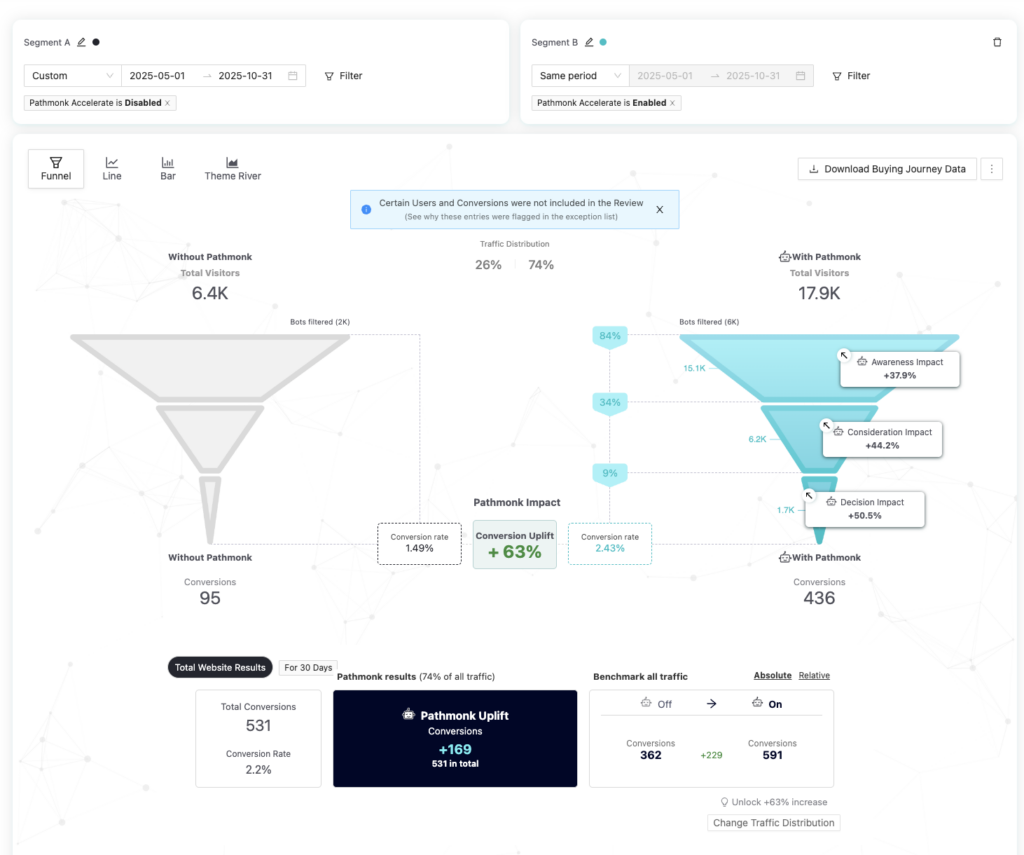
Against the control group, conversion rate rose 63%, from 1.49% to 2.43%, 169 incremental sales requests were directly attributable to Pathmonk, and sales requests surged 303% in the first week. The 2.43% still reads as roughly average for a B2B manufacturing site by benchmark, which is the point: the gain was real qualified pipeline, not a vanity number, and it came entirely from converting traffic the company already had.
Key takeaways
- The largest unworked margin in inbound is the gap between traffic a page earns and conversions it extracts, not the ranking itself.
- Sitewide conversion rate hides the gap. Measure it at the page and query-cluster level, segmented by intent and funnel stage.
- Ranking and converting are separate optimization targets. A page can win acquisition and lose conversion at the same time.
- Intent lives in the visit, not the page. The same URL receives informational, commercial, and transactional arrivals and needs to respond differently to each.
- Adapting the conversion layer is SEO-safe. Cloaking is showing the crawler different content; personalizing for users is not that.
- Manual A/B testing is too slow and low-yield for most organic pages. Real-time intent adaptation fits traffic that arrives with known intent.
- Prove organic lift with a source-segmented holdout, and read it against ranking and query data for the same window.
- AI search is absorbing low-intent informational queries, raising the average intent of the clicks that remain and increasing the payoff of conversion-side work.
FAQs on CRO strategies for SEO
Should I fix conversion before or after I improve rankings?
Fix conversion first on any page that already earns meaningful organic traffic with commercial or transactional intent, because the return is faster and fully in your control. Pursue rankings first only on pages with little traffic, where there is not yet enough volume for the conversion lever to matter.
Does personalizing pages for conversion risk an SEO penalty?
No, provided you do not cloak. Google permits A/B testing and user personalization; the violation is showing the crawler different content than you show people. Keep the indexable content identical for Googlebot and default visitors, keep variation behind the same URL, and adapt the conversion layer rather than the body copy the page ranks on.
How is the Rank-Convert Gap different from a normal low conversion rate?
A low sitewide conversion rate is an average that can be dragged down by healthy informational traffic that was never meant to convert. The Rank-Convert Gap is measured at the page and query-cluster level, isolating pages where intent is commercial, traffic is real, and the rate is still below where intent says it should be.
Why not just run A/B tests on my organic landing pages?
Because the math rarely works at organic traffic levels. Across large meta-analyses only about a quarter to a third of A/B tests reach a clear winner, a conclusive test often needs around 5,000 visitors and 100 conversions per variation, and the median test runs about a month. On a typical organic page that means a quarter per test, most of which end inconclusive.
How do I measure conversion lift from organic specifically rather than sitewide?
Segment every conversion metric to organic search by landing page, then run a holdout: keep a portion of organic traffic on the unmodified experience and compare. Without a control group, seasonality, ranking changes, and query-mix drift get mistaken for lift. Read the result against ranking and query data for the same window.
Does AI search make this work obsolete?
It makes it more valuable. AI Overviews absorb mostly informational queries, so the clicks that still reach your site skew higher intent, and AI-referred visitors convert at a higher rate than traditional organic. Fewer clicks, each worth more, rewards conversion-side work rather than retiring it.
Should branded and non-branded organic be optimized the same way?
No. Branded visitors already chose you and convert far higher, so blending them inflates your numbers and hides the non-branded gap where the opportunity is. Separate the two in reporting and show them different experiences, since a branded arrival is closer to a decision.
What traffic volume do I need before intent-based personalization beats a static page?
As a working threshold, a few thousand monthly organic sessions per page. Below that, the adaptive layer cannot learn intent fast enough to beat a single well-matched experience aligned to the dominant query intent, and a static page is the safer choice.
- Ruler Analytics’ 2026 benchmark (ruleranalytics.com)
- Databox’s B2B survey (databox.com)
- Query-intent analysis (rankdots.com)
- Google’s documented position on A/B testing and dynamic content (developers.google.com)
- Meta-analysis of 115 tests (blog.analytics-toolkit.com)
- Meta-analysis of 1,001 tests (blog.analytics-toolkit.com)